Interview with Klasol at the IFA Congress
Klasol is the newest associated group of the International of Anarchist Federations. An interview by the FA (Fédération Anarchiste) can be downloaded here in English or to read below.
https://i-f-a.org/wp-content/uploads/2026/05/Interview-klasol-IFA-congress-en_compressed.pdf
Interview with Klasna Solidarnost at the Congress of the International of Anarchist Federations
by Ouzo, Fédération Anarchiste Marseille – groupe Oaï
The full discussion will be published shortly on Radio Libertaire
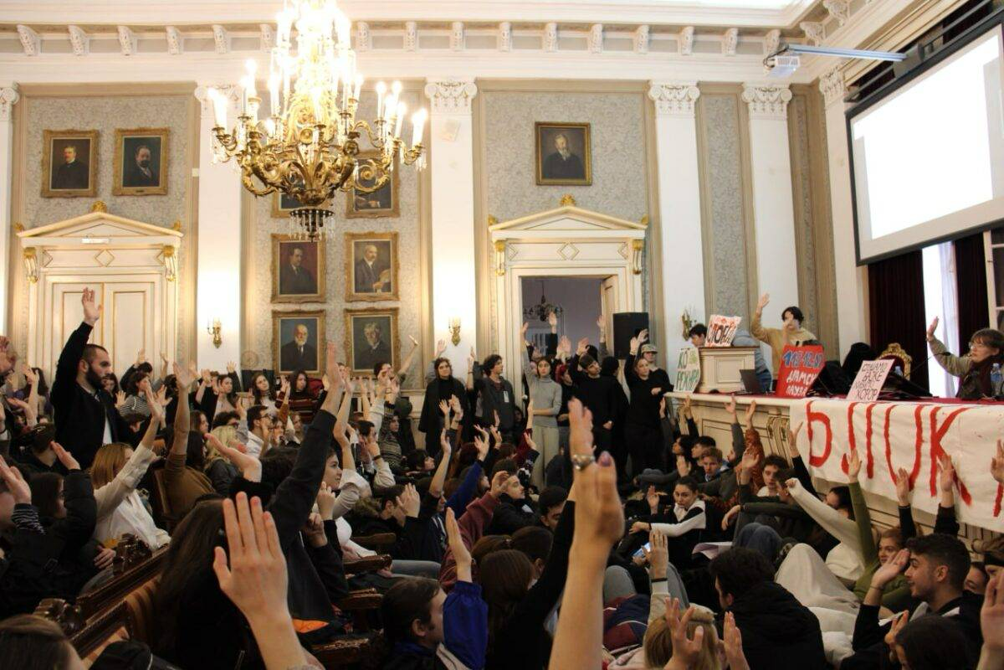
First student assembly in the occupied Belgrade Rectorate, 28 November 2024
Ouzo (FA): Hello everyone, I’m reporting live from the IFA Congress in Athens, alongside Serbian comrades. We’re going to have a discussion about their organisation – Klasna Solidarnost – a sister organisation invited to the IFA Congress which has expressed its intention to join the International of Anarchist Federations. First of all, could you introduce your organisation?
KS: Thank you for this opportunity. A few quick notes about the history of our organisation, Class Solidarity, based in Belgrade, the capital of Serbia. It was founded 10 years ago. It is the first and, to this day, the only anarchist political organisation based in Serbia. Our aim is to expend and create a federation with other groups in other towns in Serbia. We are involved in numerous struggles. Serbia is one of the post-socialist countries undergoing a rampant transition to capitalism, with privatisations that have left the working class devastated. Hundreds of thousands of people have lost their jobs, their health – many of them lost their lives.
We are on firm anti-imperialist and anti-capitalist positions. Our opposition to NATO is a key element of our activities. Our society has experienced NATO’s imperialist bombings. I was seven years old when they bombed Belgrade. We have memories that now most people in Europe only see in reels of the wars in the Middle East: you’re playing outside in the park and you just hear sirens for bombing alarm, and you run to the shelters to hide. To mark the anniversary of the NATO bombing, we hung a diy banner on a bridge of the highway, visible to thousands of cars. Some of our members are founders and active participants in the movement for Palestine in Serbia, as well as in the Antifascists of Belgrade , established six years ago with the goals of countering the rise of fascism, but also to spread the ideas of antifascism and make them more appealing to younger generations!
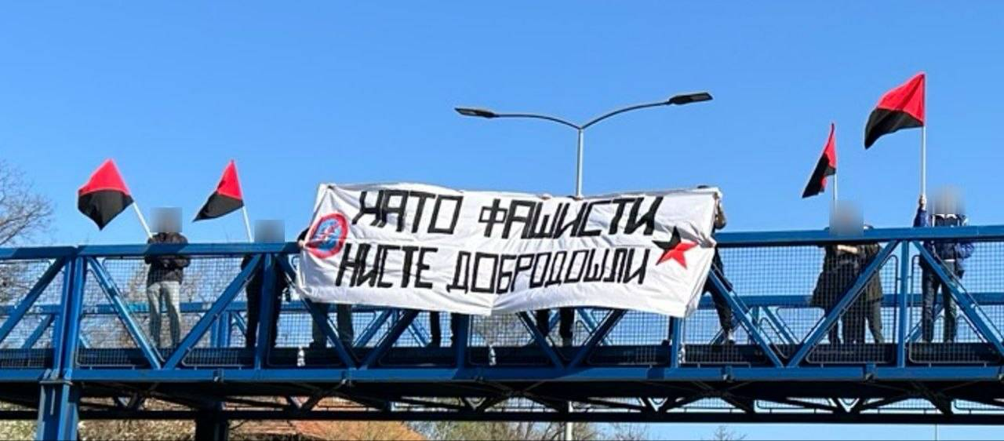
Anti-NATO protest on 24 March 2026 to mark the anniversary of the 1999 bombing of Belgrade
KS: KS is active to disconstructing the world we live in, to destroy it, but also to build a new one. Lot of our comrades were founders of horizontal student unions involved in the movement against forced evictions several years ago. There have been dozens of successful defenses of families threatened with eviction. There is also the solidarity canteen initiative (three times a week, self-managed and self-funded). Many people who are not politicized, ordinary people,are in fact doing very anarchist things, that is to say, participating in horizontal organisations based on mutual aid and which do not cooperate with institutions, the state, political parties or NGOs.
About the student initiatives. Many anarchists took part in the movements of 2006, 2009, 2011 and 2014. In Serbia there is a Student Parliament which is supposed to organise student life, but in reality it is an institution that serves no purpose other than to recruit future politicians. On the last two decades at the University of Philosophy in Belgrade, in particular, there have been occupations and student assemblies. They are anarchist in their practices; everyone has the right to speak and to vote. It is forbidden to talk about your political organisation. Occupation is also direct action. This is something that has influenced the structure of the student movement that emerged in 2024.
Ouzo (FA): Thank you comrades. I remind your Instagram @klasnasolidarnost. Could the student companions who have been holding the streets during the uprisings since 2023 share their experiences of this struggle with us, their self-organisation practices, but also the structures of capitalist society that are resisting them? (The FA had issued a statement of solidarity in November, translated by the IFA.)
KS: Those blockades and occupations of university, which happened for almost a year, was one of the biggest movement in Serbia. But why? I think the answer is in its methods of organising and making decisions. These were direct democratic assemblies from the begining of the movement. We were inspired by the experience of the Cookbook student occupation in Zagreb in 2009. Books and leaflets were distributed.
In 2023, people were revolting against the state murder after the deaths of 16 people in the collapse of Novi Sad railway station. Usually, when state crimes occur, NGOs and opposition parties co-opt the struggle and people are not motivated to participate. But this time it was really massive. As anarchists, our role is not to lead the movement but to discuss what strategies are the bests with people. We believe that people will free themselves. Praxis will change their minds.
But unfortunately, the anarchists were not organised enough to be present at all the universities, and the dominant ideology dominated. Opposition politicians and opportunistic NGOs co-opted the students’ demands towards a call for parliamentary elections. There are, however, contradictions that need to be highlighted: these assemblies are calling for elections and demanding the rule of law, whilst self-organising themselves in an anarchist way.
The positive parts and the progressive parts of the movement still exists. For example, after students called for non-students to organise themselves in the same way through neighbourhood assemblies, zborovi. They remain even now. They carry the most progressive actions. For example, clashes with the police. People have always hated the police but used to say we had to be peaceful. But after the police violence, these people realised that the police are not our friends and that the only way is to clash with the police. The assemblies also organised anti-gentrification protests against the government’s huge development projects (such as the plan to build an aquarium in place of a park). There was also a joint antifa demonstration with the students.
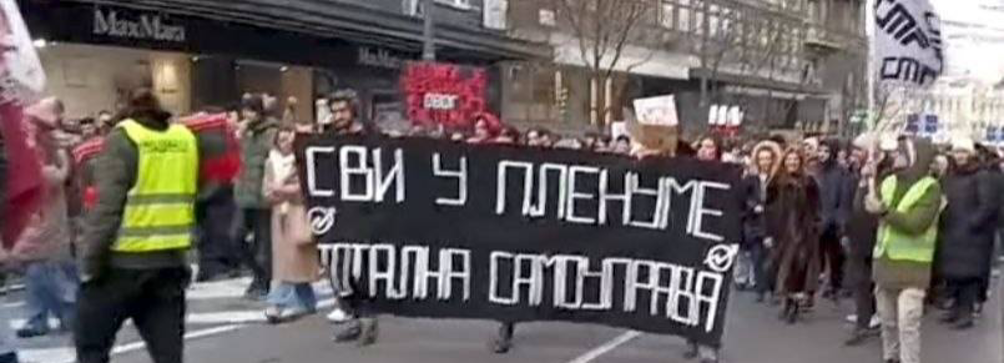
“Join the assemblies, total self-organisation”
KS: I’ve been witnessing student movements since ten years. Ten years ago, it was just the Philosophy Department; now it’s all university. Back then, we were protesting against the privatisation of the university; the demands were social and anti-capitalist, and focused on making education affordable for the working class. Now these occupations are motivated by the political situation of the country and supported by all the citizens. Of course course the demands are liberal. But what can we expect in a world where neoliberal thinking is so dominant? It’s normal for people to believe they’ll improve their lives using the tools of the system they know. But I think the praxis of the occupations is changing minds. It’s a process; we can’t win today, but it’s a process that will lead us in the right direction.
Ouzo (FA): Thank you for this information, companions. Your website to follow your struggles and analyses its klasol.org. Finally, regarding your presence at the IFA congress : how do you feel here? What are your anarchist perspectives on joining the IFA?
KS: First, a quick history that resulted in where we are today. This came as a result of our cooperation with APO (Αναρχική Πολιτική Οργάνωση, Ομοσπονδία Συλλογικοτήτων, Anarchist Political Organisation, Fededration of collectives, greek federation in the IFA), which is the host of the congress. We already cooperated with them on numerous occasion, out of which we would single out two importants in person events that our comrades were invited as guest. First last summer here in Athens for the festival of APO. And in october to Thessaloniki to the libertarian festival also organised by APO. During these times we participated on a session where we were talking about the role of anarchists in class struggle. In the context of state murders in Greece and Serbia, which we found a common link in those two tragedies.
As for the congress, I speak on my name as for personal impressions, but I am almost sure my comrades share. We are more thant honoured for the opportunity to be invited as guests/observers participants. In our opening address, we stated our firm wish to join IFA. This is because our core principle is internationalist anarchist cooperation. I myself feel fullfilled in such place, where there are people from all over the world, with different cultures, different histories, different ethnicities, different genders and different languages, and yet we all have a common goal of building a new and better world, free from capitalist exploitation.
KS: I’m also always happy to meet people with who I share my beliefs. I think its really important. Firstly, because that is what the capitalists and those in power do: they work together against us. We have to do the same. We can’t change the world if we don’t connect internationally. I feel very emotional actually. Because, as an anarchist, I sometimes feel like an utopian, fighting for something impossible, but when I meet people from all over the world that are on same positions, that are working and doing anarchist things it makes me more motivated and makes me braver to continue. Now that the world is facing wars and genocides, it is absolutely essential to be internationalists. The mechanisms are the same; we must share our strategies and our different experiences of struggle.
Ouzo: Hvala, companions. I speak for myself, but I know this feeling is shared by the Fédération Anarchiste. It’s an honour to share and forge a connection with you and your organisation. You are very welcome in France. Would you like to say a few final words?
KS: Merci, comrades, the pleasure is mutual. As for the slogan, I believe you use it in France too: Ko seje bedu, žanje bes – Who spreads misery harvest the revolt.