IFA Congress 2026 joint statement -AGAINST GLOBAL DICTATORSHIP OF STATE AND CAPITALISM, AGAINST WAR AND FASCISM – FOR ORGANIZATION, INTERNATIONALISM & SOCIAL REVOLUTIOΝ
Also in translation:
Slovenian https://anarhistka.org/ifa-proti-modernemu-totalitarizmu/
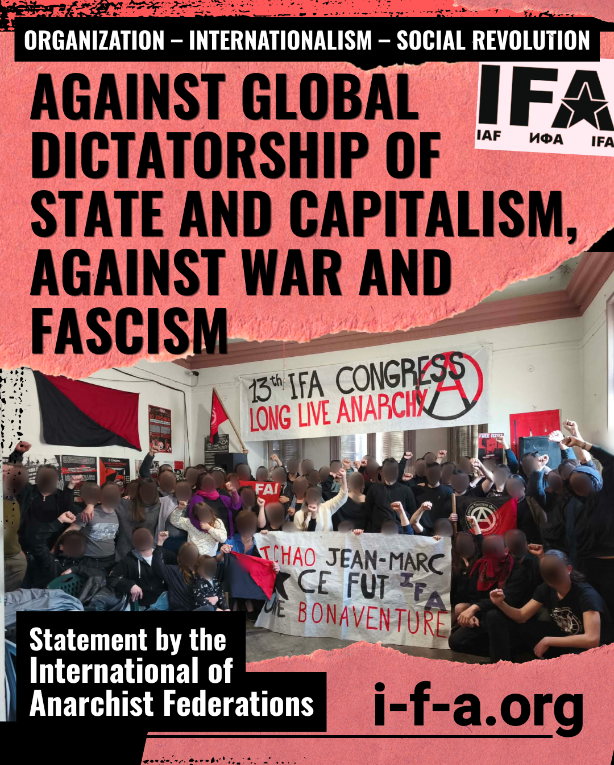
AGAINST GLOBAL DICTATORSHIP OF STATE AND CAPITALISM, AGAINST WAR AND FASCISM
ORGANIZATION – INTERNATIONALISM – SOCIAL REVOLUTIOΝ
The member federations of IFA are meeting in Athens at a time when the global situation is becoming increasingly critical for the exploited and oppressed classes. The general rearmament and the spread of war policies across various regions of the world, as well as growing authoritarianism and the rise of autocratic and reactionary models of government, is directly affecting the oppressed and is designed to maintain the capitalist and state system amidst a crisis of the dominant order.
Empires in collision
The decay and complete bankruptcy of the world of the state and capitalism marks the limit of its era of global integration, while simultaneously driving the intensification of inter-imperialist contradictions and the consequent rise of the threat of war. The state-capitalist system carries its contradictions within itself. The competition among bourgeois elites for better positioning on the chessboard—for the plunder and division of precious and limited natural resources, for the expansion of their “spheres of influence”—is what makes the sirens of war echo again and again. For as long as societies remain captive to the so-called “national interest”, to private profit, and to capitalist accumulation, war will remain the only path for empires in collision.
This is what is revealed in the most tragic way in the war slaughterhouse in Ukraine following the Russian army’s invasion four years ago, in the genocide of the Palestinian people by the state of Israel and its allies, in the brutal military intervention of the United States in Venezuela, the arming of militias in Sudan, and in the continued strangling of the people of Cuba.
US-Israel attack on Iran
Within this context, on February 28th, the US-Israel military operation against Iran was launched with intense bombardments, with the indirect support of NATO infrastructure, and continues to this day. The people of Iran, having first been drowned in blood—once again, as so many times over the years—by the regime following the popular uprising that erupted in January 2026, now find themselves facing the bombs of Western imperialism, responsible for so many military operations around the world.
The hypocrisy of Western regimes knows no bounds: at the very moment they collaborate seamlessly with all the monarchical, authoritarian, and theocratic regimes of the Middle East—Saudi Arabia, Qatar, Oman, Bahrain, and others—they instrumentalize the Islamic Republic regime in Iran to cloak their crimes in a supposed “liberating” guise, crowned by the cold-blooded murder of more than 168 children in bombardment of Minab.
Fortress Europe and increasing global repression during continuous crisis
The victims of imperialist, predatory, and neocolonial wars and interventions are always the people themselves, who are butchered in this global slaughterhouse or forced to take the road of migration only to meet death at the land and sea borders of a Fortress-like Europe. The murderous “push back” policies of the EU are reflected in the thousands of dead refugees at land and sea borders, in those trapped in modern concentration camps, and in those imprisoned under a special racist state of exception. The “walls” being raised serve not only to keep “surplus populations” out, but also to lead Western societies toward the consolidation of internal fascism, creating a social condition of fear and hatred.
Today, at a global level, we find ourselves in the midst of a historical phase of continuous reconfigurations, accelerating events, and intensifying rivalries that signal a violent transition toward a new historical period—one in which the preexisting order is in crisis, attempting to preserve its bloodsoaked gains through the intensification of repression, military escalation, and the deepening of exploitation.
Multipolar realignments and the generalization of authoritarian state power
In the dominant discourse of international politics, the “multipolar world” often appears as a more balanced and therefore more just form of global organization and hierarchy of states -a new condition of equilibrium. From the standpoint of the oppressed, and consequently from the standpoint of anarchists, the term does not describe a decentralization of power for the benefit of societies, but rather a realignment of the hierarchy of states and capitalist elites who are on a collision course. A multipolar system means that global power is distributed among multiple poles: the United States, China, Russia, the European Union, Israel, India, Iran, and other regional powers—none of which can any longer impose the rules of the game alone. This is not, therefore, a matter of less power or some retreat of power blocs, nor of a more just distribution of power. It is a matter of competition among more rulers who are vying for their places at the same table of exploitation.
The basic characteristics of such historical periods are multiple poles of power, asymmetric forms of strength, dynamic shifts in balances, and the challenging of traditional notions of sovereignty—all of which take on a different meaning when viewed through the class lens of those below. For movements and peoples, these poles are not neutral centers of influence but mechanisms of imposition and war machines, economic empires, technological surveillance systems, borders, and camps. Each power paradigm promises protection and development, demanding in return discipline, markets, natural resources, and cheap labor.
The present historical conjuncture is characterized by a double and seemingly contradictory movement: on the one hand, the attempt to transition to a multipolar world without a stable hegemonic center; on the other, the generalization of authoritarian, fascist, and totalitarian forms of governance. These two movements do not contradict each other. On the contrary, the second is a condition for stabilizing the first. Multipolarity, as has been said many times, does not give birth to peace but to generalized competition, and this competition requires disciplined, fearful societies ready to accept sacrifice as normality. Fascistization no longer manifests as a mass movement with a unified ideology, but as an everyday administrative practice. Borders that kill, police forces that function as armies of occupation, a state of exception that becomes permanent, the criminalization of poverty, migration, and solidarity. In this context, the concept of necropolitics no longer concerns only zones of violence, but the overall organization of the world. Power no longer merely manages life—it actively organizes death, whether directly or indirectly, through famines, sanctions, economic embargoes, blockades, and perpetual precarity. Death ceases to be considered as a failure of the politics of “the era of development and capitalist prosperity” and becomes its instrument for overcoming crisis conditions.
Western powers would like to force a hegemony which is not expressed simply through the politicalmilitary system. Today’s “unipolarity”, which violently unifies the planet, manifests through global capitalist integration, which expresses across different geographies the same unified logic of capitalist exploitation and state repression, incorporating within it different cultural, religious, and local particularities. While the rival blocs may seek their ideological identity on the basis of these particularities, in opposition to the dominant Western paradigm, this in no way signifies the transcendence or challenging at any level of the unified state-capitalist mechanism of power, exploitation, and oppression.
Anarchist rejection of selective anti-imperialism and opportunism
Today we are living through a period of distortion of meanings and values, and the need is even more urgent for the anarchist movement to construct its political, ethical, and ideological framework—both for the awakening of consciousness among those below and for the defense of its positions against attempts to impose foreign conceptions regarding the anarchist struggle and internationalist solidarity. These attempts are rooted in authoritarian tendencies, primarily of the left-winged politics, and are expressed through support for totalitarian state formations, condemnation of popular uprisings, alignment with power blocs, consciously false binaries, emotional blackmail, slander of militants, and threats—all dressed in the superficial cloak of anti-imperialism.
The logic of “the enemy of my enemy is my friend” always leads to the same dead end: silence about the crimes of the new and opportunistic ally, justification of their violence, and dismissal of the struggles they suppress internally. Thus, anti imperialism is transformed into a geopolitical tool, losing all its libertarian content and analytical substance.
From an anarchist perspective, this is unthinkable. There is no imperialism without the state. There is no imperialism without internal repression. The same structures that expand outward also discipline inward, within class-stratified societies. The same mechanisms bomb, imprison, torture, and exterminate—and whoever pretends not to see this is not practicing anti-imperialism but political coverup.
Proletarian internationalism does not choose states, flags, or poles through opportunistic alliances— though this does not mean it will not use the internal contradictions and cracks in the system. It chooses a side in social struggles: it stands with workers, with refugees crushed at the borders, with conscripts and deserters, with prisoners, with the insurgents—with all those who pay the cost of imperialist rivalries, wherever they are. It does not pass through foreign ministries or geopolitical calculations. It passes through internationalist solidarity from below.
In a world where new regional or even central powers are emerging, the challenge is not to choose the “right” or “oppositional” imperialism. It is to reject them all. Not to baptize the realignment of power as liberation. Not to confuse a crack in unipolarity with a rupture with the system. A rupture with the system occurs when we deepen these cracks, make them more profound and insurrectionary.
Our position is clear: against every pole, against every state, against every war of the masters. With those from below, without taking sides or accepting false choices. This is the only anti-imperialism that does not betray itself.
Appeal for internationalism and deeper connections
The dynamic changes and upheavals that the rulers pursue demands the rapid reorganisation of the anarchist current at an international level. The urgent need to expand the network of contacts and communication among anarchists internationally is proven by the facts themselves—with the primary aim of exchanging experiences, sharing information about how the politics of domination are taking shape in each geography, and about the social resistances emerging at every point of the planet. Furthermore, discussion at the international level regarding the war condition and the generalized threat of war is critical, as deepening this discussion—along with the corresponding cooperation of anarchists internationally—are basic prerequisites for strengthening the struggle, that is, the social and class resistances themselves that can protect societies from the threat of war and the intensification of exploitation and repression.
It is literally a matter of life and death—for the movement, for societies, and for the oppressed—to develop and adopt the most coherent possible anarchist stance toward militarism, the threat of war, and resistance to global domination. We believe this can be achieved if comrades all over the world manage to recognize that while there are visible historical, political, social, and even cultural differences among particular societies (and therefore among movements)—which are necessarily formed under the shadow of the nation-state and which must be respected—at the same time, it must be noted that today’s anarchist analysis identifies a unified state and capitalist condition that dominates and oppresses the entire planet.
Against this condition we must stand in unity—whether it is expressed through the warmongering hegemonic Western coalition of the USA-NATO-Israel, through bellicose Russian authoritarianism, through the oppressive obscurantism of Islamic regimes, or through bureaucratic Chinese state totalitarianism.
Solidarity with struggles across the globe
For our part, based on our principles and values as organized anarchists, we intervene and act in the fields of social and class struggle, aiming for class and social emancipation against every form of tyranny—not to serve one or another tyrannical regime, state, or interstate bloc. We stand in solidarity alongside every people fighting for survival, dignity, land, and freedom against the global dictatorship of the state and capitalism, colonialism, and imperialism. We draw inspiration from people struggling across the entire world who, facing the monster of fascism, state and capitalist barbarism, rise up, strike, demonstrate, and fight the brutality of power. These are the elements of struggle we wish to highlight as anarchists: the ability of the conquered to counterattack against the all-powerful conqueror, the capacity of the poor and excluded to revolt under even the most barbaric conditions. We want international solidarity to create ruptures within the attacking rulers, bringing to the forefront our own history—the history of the struggles of those below who, against all times, create the living reality of freedom and solidarity, constituting the only real bulwark against the advance of modern totalitarianism.
Until the total liberation of all people from the chains of the state and capital—until the Social Revolution for a world of equality, solidarity, and freedom.
International of Anarchist Federations (IFA-IAF)
April 3–5 2026 – Athens, Greece